


Does coffee dehydrate you? What studies say about coffee and hydration
Coffee and a glass of water: where the question comes from
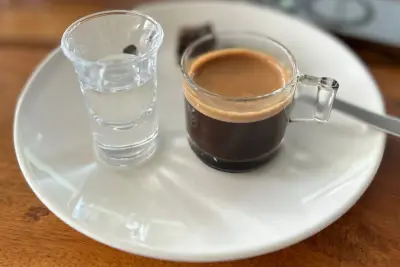
A cup of espresso with a glass of water beside it: in Italian bars and in many Polish cafés this pairing surprises no one.
Many people see in it a confirmation of the common belief that coffee dehydrates and that every cup has to be made up for with water.
Something similar happens at home: many people instinctively put water next to their coffee, or drink a glass after every cup.
Others give up their afternoon coffee for fear that it will take away more fluid than it provides.
The question comes up especially in summer and whenever everyday habits are discussed.
But how much truth is there in it?
The good news is that the subject has been studied many times, and the conclusions are more reassuring than one might expect.
To understand them, it is enough to separate two things: the effect of caffeine itself and what happens after drinking an ordinary cup of coffee.
In this article we explain where the belief that coffee dehydrates comes from.
We describe what studies have observed in people who drink coffee regularly and in moderate amounts, and what they have observed with larger single doses of caffeine.
We also suggest how, in practice, to combine coffee with water and other drinks during the day.
The article is for information only and does not replace the advice of a doctor or a dietitian.
Where the belief that coffee dehydrates comes from
The source of this belief is caffeine, a natural component of coffee.
Caffeine has a mild diuretic effect, which was described in studies many decades ago.
The word diuretic means that a substance increases the amount of urine produced.
This effect is linked to caffeine itself, regardless of the drink in which it is found.
In some of those early studies participants were given larger doses of caffeine, often after a period in which they had not taken any.
Under these conditions a short-lived increase in the amount of urine passed was observed.
From these observations grew the simple conclusion that coffee takes more water from the body than it provides.
A similar opinion can be heard about tea, which also contains caffeine.
This conclusion, however, overlooks several important circumstances.
First, a cup of coffee is mostly water, which we drink together with the caffeine.
Second, the body of someone who drinks coffee every day becomes accustomed to caffeine, and its diuretic effect usually weakens.
That is why the same cup may affect someone who drinks coffee every day differently from someone who has it only now and then.
Third, a larger single dose of caffeine is one thing, and a cup of coffee drunk with breakfast or after lunch is another.
We describe how much caffeine different coffees contain in our article on caffeine in the cup.
What studies on coffee and hydration have observed
In recent decades several research teams have examined how drinking coffee affects the body's fluid balance.
In some studies the same people drank moderate amounts of coffee for several days and, in another period, the same amount of water.
This design makes it possible to compare, in each person, the period with coffee and the period with water.
The researchers assessed, among other things, body weight, the amount of urine produced and markers measured in blood and urine.
In participants accustomed to coffee, no significant differences in hydration markers were found between the two periods.
Reviews of studies similarly indicate that moderate caffeine intake in people who consume it regularly does not usually lead to a loss of fluid greater than the amount of the drink consumed.
In these studies, then, coffee drunk regularly and in moderate amounts did not lead to a clearly greater loss of fluid than the same amount of water.
A more marked diuretic effect has been described mainly after larger single doses of caffeine, especially in people who do not normally consume it.
This is why many dietary recommendations count coffee and tea towards the daily amount of fluids drunk.
It is worth knowing, however, what these studies do not prove.
They were usually carried out in small groups of healthy adults, over a short time and under specific conditions.
They do not show that coffee hydrates better than water, nor that it can replace other drinks.
Nor do they show how a particular person will react, because sensitivity to caffeine can vary greatly.
We have gathered a wider overview of what is known about coffee and health in our article on coffee and health in the light of research.
Type of coffee and amount of caffeine: what may matter
In any discussion of coffee and hydration, the number of cups matters, and so does the type of drink.
A small espresso contains little water, so it can hardly be treated as an important source of fluids, even when several are drunk in a day.
Longer coffees, such as an americano or filter coffee, provide considerably more.
A lungo, too, made with more water, gives more fluid in the cup than a classic espresso.
Drinks with milk, for example a cappuccino or a latte macchiato, consist largely of milk, and so of fluid as well.
Most of the day's fluids usually come from water and other drinks, and a certain amount also from food, for example soups, vegetables and fruit.
The amount of caffeine depends, among other things, on the species of bean: blends with a larger share of Robusta usually contain more than coffees made from Arabica alone.
European food safety institutions indicate amounts of caffeine that raise no concerns for healthy adults, and it is to these that the expression moderate intake usually refers.
Larger amounts of caffeine drunk in a short time may, in some people, increase the need to use the toilet and cause restlessness.
Caffeine is also found in tea, cola-type drinks, energy drinks and cocoa, so it is worth looking at the whole day and not only at coffee.
Decaffeinated coffee contains far less caffeine, although the decaffeination process does not remove it completely.
It can be a good choice for those who enjoy the taste of coffee in the afternoon and evening, as we describe in our article on decaffeinated coffee and infusions.
You will find various blends, including decaffeinated ones, in our coffee beans and ground coffee section.
Decaffeinated versions are also available in other formats, for example as coffee in ESE pods.
Coffee and water during the day: a few practical tips
Coffee can be part of the daily fluid balance, but water remains the basic drink.
In Italian bars espresso is often served with a glass of water.
According to a widespread tradition it is drunk before the coffee, to prepare the palate and better appreciate the aroma, though this is not a binding rule.
The custom is therefore linked above all with taste, and at the same time it helps one remember to drink water.
So why not make a glass of water a regular part of coffee at home?
Three simple habits can prove useful from day to day:
A glass of water with the coffee, set beside the cup as in an Italian bar.
A jug or bottle of water within reach, on the desk or on the kitchen worktop, so that it is also drunk between coffees.
A gentler drink in the afternoon, for example a decaffeinated coffee or an infusion.
You will find herbal and fruit infusions, which usually contain no caffeine, in our tea section.
Black and green tea, on the other hand, do contain caffeine, which is worth knowing when choosing a drink for the evening.
On hot days and during physical exertion the need for fluids usually rises.
At such times having water to hand is especially useful, whatever the number of coffees drunk.
We write about coffee before and after training in our article on coffee and sport.
When it is wise to be cautious and talk to a doctor
The observations described concern healthy adults who drink coffee in moderate amounts.
During pregnancy and breastfeeding it is usually recommended to limit caffeine, and the appropriate amount is best discussed with a doctor.
The same applies to kidney and heart conditions, high blood pressure and when taking medication, including diuretics.
In such situations the amount of coffee and fluids is for the doctor to decide.
Children and adolescents are a separate group: in their case the choice of drinks should take into account age, caffeine and sugars.
In older people the sensation of thirst can be weaker, so drinking water regularly is particularly important for them.
With fever, vomiting or diarrhoea the body loses more fluid, and how to replace it is best discussed with a doctor or pharmacist.
People who are particularly sensitive to caffeine may feel its effects even after small amounts.
The same remarks apply to other drinks containing caffeine, including strong tea and energy drinks.
If worrying symptoms appear after coffee, for example palpitations or marked restlessness, it is worth discussing them with a healthcare professional.
A simple look at one's own day can help: how many cups of coffee and how many glasses of water appear on the table from morning to evening.
For most healthy adults the conclusion from the studies is reassuring: a moderate amount of coffee drunk regularly does not usually upset the fluid balance.
In the end, a cup of espresso and a glass of water go well together: coffee gives flavour and a moment's break, while water remains the basic drink of the day.
If you are looking for a milder coffee, a decaffeinated one or an infusion for the evening, contact us: the Maracatú team is always happy to help you choose.
Popular products
All products
More







More on this topic
More

Coffee capsules vs traditional: what to choose for home?
Read article


Coffee Capsules Guide: How to Choose Your Perfect Taste
Read article

5 myths about capsule coffee
Read article
How to properly store coffee and coffee capsules: expert advice
Read article

Coffee at the office: choosing the system, the machine and the accessories for a team
Read article

What to serve with coffee the Italian way: sweets, pistachio creams and specialities
Read article

Decaf coffee and infusions: what to drink in the afternoon and evening
Read article
How to taste coffee at home: a guide for beginners
Read article
Coffee brewing methods: moka pot, espresso, French press and filter — which to choose
Read article
Used coffee grounds: what to do with them instead of throwing them away
Read article

Coffee and sport: when caffeine helps and when it gets in the way
Read article

Caffeine in the cup: how much we really drink
Read article