


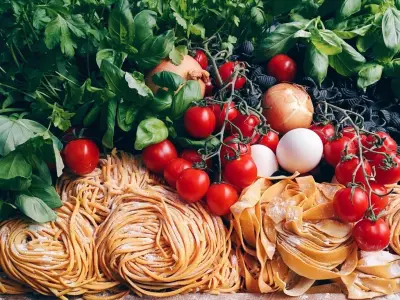
Italian pasta: how to match the shape to the sauce
Pasta and sauce: why the shape matters
A pot of boiling water, a sauce slowly thickening in the pan and a packet of pasta waiting on the worktop: this is how many home meals in the Italian style begin.
Before the pasta goes into the water, however, a question comes up: spaghetti, penne or fusilli?
In Italy there is a wide variety of pasta shapes, and many of them have long been linked to particular sauces.
This is no coincidence. The shape determines how the pasta holds the sauce: long strands are coated by it, tubes collect it inside, and ridges and twists keep it on the surface.
As a result, the same dish can taste different when only the type of pasta changes.
In this guide we look at the best-known pairings: long and short pasta, ridged and smooth, small shapes for soups and filled pasta.
We also explain how to cook pasta al dente and how to end the meal the Italian way, with a cup of espresso.
The pairings we describe are well-tried classics, which in Italian homes vary from region to region and from family to family.
You will find pasta in many shapes, long and short, classic and gluten-free, in our Italian flavours section, depending on the current range.
Long pasta: spaghetti, linguine, bucatini and tagliatelle
Long pasta is usually divided into thin strands and wider ribbons.
Very thin strands, for example capellini, are chosen for the lightest sauces and for broth.
Spaghetti and the thinner spaghettini go well with smooth, fluid sauces that coat every strand evenly.
Classic examples are tomato sauce or aglio, olio e peperoncino, that is garlic, olive oil and chilli.
In such a simple dish a great deal depends on the oil. You will find extra virgin olive oils with us among the products of the Quattrociocchi brand, among others.
Just as simple is the Roman cacio e pepe, in which the sauce is made from pecorino cheese, pepper and a little of the pasta cooking water.
Linguine have a slightly flattened cross-section. They are often served with seafood or with pesto.
Bucatini look like thick spaghetti with a hole through the middle. A well-known pairing is amatriciana sauce, made with tomatoes, pecorino cheese and guanciale, a cured pork product.
Wider ribbons such as tagliatelle, fettuccine or pappardelle have a larger surface and therefore take thick, hearty sauces well.
The best-known example is tagliatelle with meat ragù, associated with Bologna.
Mushroom sauces and cream-based sauces also go well with ribbons.
A shape of its own is spaghetti alla chitarra, associated with Abruzzo. It has a square cross-section and takes its name from the stringed tool traditionally used to cut the dough.
As a general guide: the more delicate the sauce, the thinner the pasta, and the thicker the sauce, the wider the ribbon.
Short pasta: penne, rigatoni, fusilli and farfalle
Short pasta has hollows, holes and twists in which pieces of vegetables, meat and thick sauce are caught.
Penne are tubes cut at an angle. They suit tomato sauces, for example the spicy arrabbiata, and baked pasta dishes.
Rigatoni are wider and clearly ridged. They combine well with hearty meat and vegetable sauces, which fill them inside.
The shorter mezze maniche behave in a similar way, as do the large paccheri, associated with Campania and often served with seafood or tomato sauces.
Fusilli are shaped like a spiral that holds the sauce. They work well with pesto, with sauces of finely chopped vegetables and in pasta salads.
Farfalle, often called bow-tie pasta, are usually paired with light sauces and are also served cold, in salads.
Shells, or conchiglie, scoop the sauce up inside, so they go well with sauces containing small pieces of vegetables or meat.
Orecchiette, small concave discs associated with Apulia, are traditionally served with cime di rapa, that is turnip tops.
The twisted casarecce also hold sauce well, whether tomato sauce or pesto.
Short pasta is also a practical choice for baked dishes, because it keeps its shape and is easy to serve.
As a general guide: the larger the pieces in the sauce, the better a pasta with larger holes and hollows works.
Ridged, smooth, small and filled: other differences
Besides length, the surface of the pasta also matters.
On the pack, the Italian word rigate means ridged pasta, and lisce means smooth pasta.
Ridges help to hold the sauce, which is why ridged pasta is often chosen for thick sauces. Smooth pasta has a more delicate texture and combines well with lighter sauces.
The way the pasta is made also matters. Pasta extruded through bronze dies, described as trafilata al bronzo, usually has a rougher surface to which sauce clings more easily.
Small shapes, known in general as pastina, for example little stars or short tubes, are most often used in soups and broths.
Well-known examples are pasta with beans, pasta e fagioli, and pasta with chickpeas, pasta e ceci, for which small tubes such as ditalini are often used.
Filled pasta such as ravioli and tortellini carries its flavour in the filling, which is why it is usually served with simple accompaniments.
Classic pairings are butter and sage, a light tomato sauce or broth, in which tortellini are traditionally served.
Gnocchi, small dumplings most often made from potatoes, are served in a similar way to pasta. Tomato sauce, butter and sage, and pesto all go well with them.
It is also worth looking at the ingredients. Italian dried pasta is usually made from durum wheat semolina and water, while egg pasta also contains eggs.
Wheat pasta contains gluten. Gluten-free versions are also available, for example made from maize or rice, and in the case of allergies or intolerances it is always advisable to read the label.
How to cook pasta al dente
Even the best-chosen shape needs to be cooked properly.
In Italy pasta is usually served as a first course, the primo piatto, often followed by a main course. For this reason portions there tend to be small.
The expression al dente literally means "to the tooth": the pasta is cooked but still slightly firm when bitten.
Pasta is cooked in a large pot with plenty of water, so that it can move freely.
The water is usually salted once it has come to the boil, just before the pasta goes in.
It is worth stirring the pasta at the beginning so that it does not stick together. Adding oil to the water is then not necessary.
The cooking time is best checked on the pack, because it depends on the shape, the thickness and the producer.
Many people taste the pasta shortly before that time is up, so as to take it out at the right moment.
Before draining, it is a good idea to set aside a little of the cooking water. It contains starch and helps to bind the sauce to the pasta.
In Italy pasta is often finished in the pan: once drained, it is added to the sauce and stirred over the heat for a moment.
Pasta served hot is usually not rinsed, because the starch on its surface helps the sauce to cling.
At the end, many dishes are sprinkled with grated cheese, for example Parmigiano Reggiano or pecorino.
According to a widespread custom, cheese is usually not added to pasta with fish and seafood.
Pasta is served straight after it has been mixed with the sauce, while it is hot.
After the pasta: an espresso to end the meal
In Italy a meal often ends with a small cup of espresso.
It is usually served at the very end, after dessert or fruit, as a short, intense note that closes the time at the table.
Cappuccino and other coffees with milk, on the other hand, are traditionally associated with the morning, as we explain in our guide to Italian coffee types.
After a generous lunch many people choose an espresso without milk, in a small, warmed cup.
At home, coffee after a meal can be made with a machine, a moka pot or pods. Blends for different methods can be found in the coffee beans and ground coffee section.
Those who limit caffeine in the evening can choose decaffeinated coffee. The decaffeination process greatly reduces the caffeine but does not remove it completely.
We write more about this in our article on decaffeinated coffee and infusions.
Something small and sweet is often served with the coffee: a chocolate, a piece of nougat or a crumbly biscuit.
You will find such treats in the Italian sweets section, and ideas for serving them in our article on what to serve with coffee the Italian way.
To sum up, thin strands go with smooth sauces, wide ribbons with thick ones, tubes and spirals with chunky sauces, and filled pasta with simple accompaniments.
In the end, a pot of boiling water, a well-chosen shape and a favourite sauce are enough to give an ordinary meal an Italian character, with a cup of espresso to round it off calmly.
If you would like to choose pasta, olive oil or coffee for an Italian meal, contact us: the Maracatú team is always happy to help you choose.
Popular products
All products
More




More on this topic
More

Coffee capsules vs traditional: what to choose for home?
Read article


Coffee Capsules Guide: How to Choose Your Perfect Taste
Read article

5 myths about capsule coffee
Read article

How to properly store coffee and coffee capsules: expert advice
Read article

Coffee at the office: choosing the system, the machine and the accessories for a team
Read article
What to serve with coffee the Italian way: sweets, pistachio creams and specialities
Read article

Decaf coffee and infusions: what to drink in the afternoon and evening
Read article

How to taste coffee at home: a guide for beginners
Read article
Coffee brewing methods: moka pot, espresso, French press and filter — which to choose
Read article
Used coffee grounds: what to do with them instead of throwing them away
Read article

Coffee and sport: when caffeine helps and when it gets in the way
Read article

Caffeine in the cup: how much we really drink
Read article