


Italian aperitivo at home: how to prepare it and what to serve
Aperitivo: the Italian custom of meeting before dinner
Late afternoon, a few glasses on the table, a small bowl of olives, crunchy breadsticks and little toasts with a spread: the guests are only just arriving and the gathering has already begun.
This is the aperitivo, the Italian custom of having a light drink and a small snack before dinner.
The aperitivo usually takes place in the late afternoon or early evening, between the end of work and dinner.
In Italian bars the drink you order often comes with small snacks, from olives and crisps to little sandwiches.
The name itself goes back to the Latin word for opening: the aperitivo is meant to open the evening and announce dinner.
In Venice, the small snacks served with a glass of wine are called cicchetti.
What matters most is the get-together: a chat after work, a moment with friends or a calm start to a family evening.
When there are so many snacks that they replace dinner, Italians sometimes speak of an apericena, a blend of the words aperitivo and cena, meaning dinner.
The good news is that an aperitivo is easy to prepare at home, without cooking and without complicated recipes.
An evening like this can also be a simple way of entertaining guests without preparing a full dinner.
In this guide we suggest what to serve to eat and drink, including alcohol-free options, how to set the table and how to end the gathering with something sweet and a cup of coffee.
All the suggestions can be freely adapted to your own home, the number of guests and their tastes.
What to serve: spreads, olives and something crunchy
Aperitivo snacks are small, simple and easy to eat with your fingers or a cocktail stick.
The following often appear on the table:
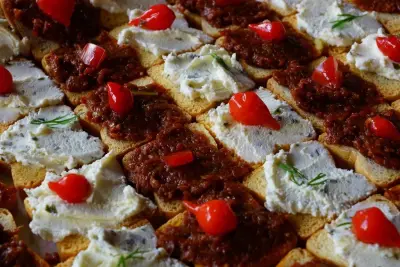
Vegetable spreads and pâtés, for example made from olives, artichokes, asparagus or sun-dried tomatoes, served on small toasts.
Olives, green and black, served in a small bowl, with a separate dish for the stones.
Grissini and taralli, that is crunchy breadsticks and small crisp rings, which can be eaten on their own or with a spread.
Bruschetta, a slice of toasted bread rubbed with garlic and drizzled with olive oil, often topped with chopped tomatoes.
Nuts, almonds and crisps, which in Italian bars are often served with the drink as the simplest accompaniment.
Small toasts with toppings are called crostini in Italian. All you need is a thinly sliced baguette or loaf, lightly toasted in the oven or in a pan.
Focaccia cut into small squares, with olive oil and rosemary, also works well as a snack.
Tramezzini, small triangular sandwiches made of soft crustless bread, are popular too.
Ready-made spreads in jars make it possible to offer several different flavours without cooking.
In our Italian flavours section you will find, among other things, vegetable spreads and pâtés, depending on the current range.
We offer vegetable pâtés and extra virgin olive oils under the Quattrociocchi brand, among others.
A good olive oil is also useful on its own: a small bowl of oil and pieces of bread for dipping are enough.
Cheese, cured meats and vegetables: how to arrange a board
The second important element of an aperitivo is the board, in Italian tagliere, on which cheeses, cured meats and accompaniments are arranged.
Among cheeses, popular choices are Parmigiano Reggiano served in irregular chunks, pecorino and small mozzarella balls.
A little honey or jam, for example fig jam, goes well with hard cheeses.
Blue cheeses such as gorgonzola are often paired with pear or walnuts.
Among cured meats, prosciutto crudo, salami and mortadella often appear, sliced very thinly.
Vegetables add colour and freshness: cherry tomatoes, artichokes and sun-dried tomatoes in oil, grilled peppers or courgettes.
Raw vegetables cut into sticks and served with olive oil, salt and pepper for dipping are the Italian pinzimonio.
Fruit also looks good on the board, for example grapes, figs or slices of pear.
When arranging it, it is worth aiming for variety: something salty, something mild, something crunchy and something fresh.
For guests who do not eat meat, a separate board with cheeses, vegetables and vegetable spreads can be prepared.
Cheeses are taken out of the fridge a little earlier, so that they have time to develop their flavour and aroma.
Products that need to be kept chilled, such as cheeses and cured meats, are best put out in smaller portions and topped up during the gathering.
With snacks for guests, allergens matter too, and their presence depends on the specific product.
For this reason it is always advisable to read the labels and check whether a product contains, for example, gluten, milk, nuts, fish or sulphites, and also to ask guests about allergies and intolerances.
Drinks: the classics with alcohol and alcohol-free versions
The aperitivo drink is usually light, well chilled and often has a slightly bitter taste.
One of the best known is the spritz, made with sparkling wine, a bitter liqueur and sparkling water, served with ice and a slice of orange.
A glass of prosecco or white wine, or vermouth on ice, is also often served. Well-known cocktails include the Negroni, based on gin, vermouth and a bitter liqueur, and the Americano, in which vermouth and a bitter liqueur are combined with sparkling water.
A slice of orange or lemon, an olive or a sprig of herbs is added to many drinks.
Alcoholic drinks are intended for adults only and should always be enjoyed in moderation.
An aperitivo does not require alcohol, however. In Italian bars the alcohol-free version is called analcolico and is entirely usual.
A classic example is chinotto, a dark fizzy drink with a slightly bitter taste, made from the citrus fruit of the same name.
Sparkling water with ice, slices of citrus fruit and a sprig of rosemary or mint also works well.
Juices are another option, for example tomato juice seasoned with salt, pepper and lemon, or orange juice topped up with sparkling water.
Fruit and herbal infusions served cold, with ice and a slice of lemon, are another interesting option. Various flavours can be found in our teas and infusions section.
Coffee lovers can prepare a caffè shakerato, that is espresso shaken with ice. It contains caffeine, which is why in the evening some people choose a version made with decaffeinated coffee.
We write about decaffeinated coffee, which contains far less caffeine but is not completely free of it, in our article on decaffeinated coffee and infusions.
It is a good idea to prepare at least one alcohol-free option, with guests in mind who do not drink alcohol or who are driving.
A jug of plain water on the table is useful too.
How to prepare an aperitivo at home: table, portions and timing
An aperitivo at home does not call for great preparations, but a few things are worth planning ahead.
Most of the snacks can be prepared before the guests arrive: slicing the bread, putting the spreads into small bowls, arranging the board.
The toasts are best toasted shortly before serving, so that they stay crunchy.
A practical solution is a single table or worktop where everyone helps themselves.
Small plates, napkins, cocktail sticks, teaspoons for the spreads and a separate little bowl for olive stones all come in handy.
Small cards with names can be placed next to the spreads and cheeses, which makes choosing easier for guests with allergies.
The amount of food depends on what comes next. If dinner is planned after the aperitivo, a few small snacks are enough.
If the gathering is to replace dinner, it is worth preparing more kinds of snacks and adding a salad or a cold pasta dish.
It is a good idea to chill the drinks in advance and to have a good supply of ice ready.
Glasses can be set out next to the drinks, so that guests can pour for themselves.
It is a good idea to leave some free space on the table, so that guests can put down their glass and plate.
Small details also create the atmosphere: quiet music, a few candles, a tablecloth or wooden boards instead of plates.
In summer the aperitivo can be moved to the balcony or the garden, and in winter it can be held around the kitchen table or in the living room.
It is worth leaving yourself time to sit down with your guests, because an aperitivo is above all an occasion for conversation.
To finish: something sweet and a cup of espresso
When the aperitivo replaces dinner, many people like to finish it with something sweet.
It need not be a large dessert. A few small sweets are enough: chocolates, a piece of nougat, crumbly biscuits.
In Italy, small almond biscuits such as amaretti or cantucci are sometimes served with coffee.
The sweets can be served on a small plate or in a bowl, so that everyone can choose something for themselves.
You will find ideas for such an occasion in the Italian sweets section.
We have described more ideas in our article on what to serve with coffee the Italian way.
A small cup of espresso, with which an evening meal in Italy often ends, goes well with the sweets.
At home, the coffee to finish with can be made with a machine, a moka pot or pods. Coffees for different methods can be found in the coffee beans and ground coffee section.
Guests who avoid caffeine in the evening can be offered decaffeinated coffee or a warm herbal infusion.
To sum up, an aperitivo at home consists of a few simple elements: small snacks, a light drink, alcohol-free if preferred, and a table where everyone helps themselves.
In the end, a small bowl of olives, a few toasts with a spread and good company are enough to turn a late afternoon into a little Italian evening.
If you would like to choose spreads, olive oil, sweets or coffee for such a gathering, contact us: the Maracatú team is always happy to help you choose.
Popular products
All products
More



More on this topic
More

Coffee capsules vs traditional: what to choose for home?
Read article


Coffee Capsules Guide: How to Choose Your Perfect Taste
Read article

5 myths about capsule coffee
Read article
How to properly store coffee and coffee capsules: expert advice
Read article

Coffee at the office: choosing the system, the machine and the accessories for a team
Read article
What to serve with coffee the Italian way: sweets, pistachio creams and specialities
Read article

Decaf coffee and infusions: what to drink in the afternoon and evening
Read article

How to taste coffee at home: a guide for beginners
Read article
Coffee brewing methods: moka pot, espresso, French press and filter — which to choose
Read article
Used coffee grounds: what to do with them instead of throwing them away
Read article

Coffee and sport: when caffeine helps and when it gets in the way
Read article

Caffeine in the cup: how much we really drink
Read article