





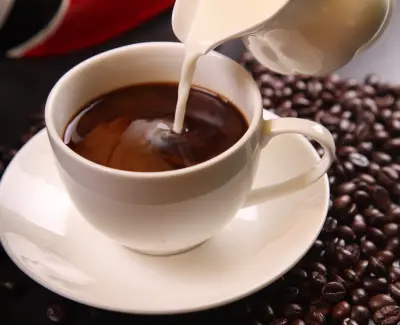
Coffee and diet: how many calories coffee has and what really adds them
Black coffee: a few calories
Customers ask us about the calories in coffee regularly. The answer is simpler than the headlines suggest: coffee on its own has almost none. The energy in the cup comes from what is added to it.
Brewed coffee is water with a small amount of material extracted from the bean: acids, oils, traces of protein and carbohydrate. In nutrition tables a cup of black filter coffee is around two kilocalories, a single espresso at one to three; in the balance of a whole day they can be ignored.
That is why this post looks at what goes into the cup after brewing, and at what studies observe about caffeine, appetite and hydration.
Coffee and health is covered in our post on coffee and health, caffeine in different servings in the post on caffeine in the cup. Here we count energy only.
Milk: type, fat content and size of the drink
The largest source of calories in coffee is milk, or more precisely its quantity and fat content. Whole milk, at around 3.5 percent fat, has roughly 60-65 kilocalories per 100 millilitres; semi-skimmed usually 45-50, skimmed around 35.
The difference between types of milk is smaller than the difference between drinks. An espresso macchiato is a spoonful of foamed milk, a cappuccino holds roughly 100 millilitres of milk, a caffè latte or latte macchiato twice that or more, in a large cup as much as 250-300. A large latte on whole milk is therefore comparable to a small snack. This is not an argument against milk, just worth knowing when choosing the size of the drink.
Plant-based drinks vary enormously: unsweetened almond drink has around fifteen kilocalories per 100 millilitres, soy and oat come close to semi-skimmed milk, and barista versions often contain added oil and reach values similar to whole milk. The only reliable method is the label.
The coffee itself stays constant: an espresso blend from our beans and ground coffee or a capsule, the brew brings the same few kilocalories to the cup.
Sugar, syrups and whipped cream
A teaspoon of sugar is about four grams, or around fifteen kilocalories. One in one coffee changes little; two in each of three coffees a day add up to tens of kilocalories a day, all year round. It is this mechanism that decides the outcome, not the single cup.
Flavoured syrups work the same way, only less visibly: a serving of vanilla or caramel syrup is usually a few teaspoons of sugar dissolved in flavoured water, several tens of kilocalories that cannot be seen at the bottom of the cup.
Whipped cream adds fat and sugar at once. A coffee with a cap of cream and toppings, like an iced coffee with ice cream, is in practice a dessert in a cup: a pleasure now and then, not the everyday drink. For sweetened bottled coffees, the packaging tells the whole story.
In short: the taste of the additions is obvious, their energy is hidden. Black coffee shows everything at once, a sweetened coffee drink only on the label.
Capsule drinks and ready-made preparations
In capsule systems the distinction is simple. A coffee capsule, whether espresso, lungo or ristretto, contains only ground coffee and gives a few kilocalories in the cup, just like a portafilter machine. Original or compatible makes no difference.
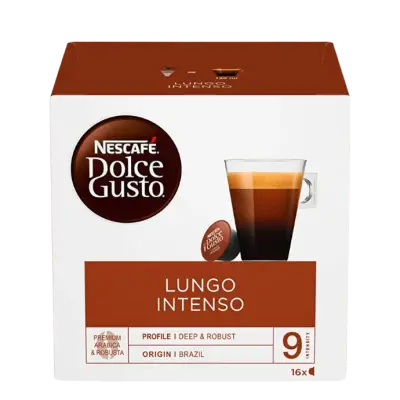
Milk drinks are different. In systems such as Dolce Gusto® a latte macchiato or cappuccino is made from two capsules, one with coffee and one with milk; the milk capsule as a rule contains milk powder and often sugar as well, as the ingredient list on the box shows. Such a drink is convenient and consistent, but energetically it corresponds to a coffee with milk and sugar, not to a black coffee.
The same goes for flavoured capsules and for chocolate or hazelnut drinks: their base is milk powder, sugar and flavouring, with little or no coffee. This is not a flaw, just a different category, closer to hot chocolate than to espresso.
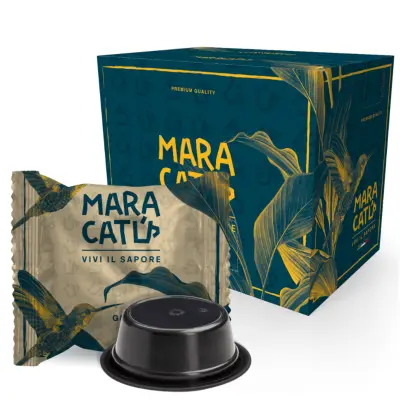
In our Dolce Gusto® section, alongside coffee-only capsules there are also milk and flavoured variants; the Nespresso® section is dominated by pure coffee capsules, decaf included. Maracatú capsules in their espresso versions contain nothing but ground coffee; for the flavoured variants the ingredients are in the product description.
The rule is the same whatever the system: if the name of the drink mentions milk, chocolate or a flavour, read the label. If it mentions coffee only, there is nothing to count.
Caffeine, appetite and hydration: what studies observe
Studies that measured how much people ate after drinking coffee usually observe a small, short-lived reduction in appetite. With habitual consumption the effect fades, and over the longer term no lasting difference in body weight emerges. The brief rise in energy expenditure after coffee is just as small. Coffee is therefore not a tool for controlling appetite.
In common intermittent fasting schemes, black coffee without additions is usually permitted during the hours without food, precisely because it brings negligible energy; any addition, from milk to syrup, changes that. We do not judge the schemes, only note why black coffee appears in them so often.
A separate myth concerns hydration. Caffeine has a mild diuretic effect that is barely noticeable in regular coffee drinkers, and European nutrition bodies count all beverages, coffee included, towards the daily water requirement. A moderate amount of coffee therefore counts towards daily fluids, not against them.
During pregnancy and breastfeeding, with chronic conditions or when taking medication, the amount of coffee should be agreed with a doctor or dietitian; this text does not replace that conversation.
A few habits that change the balance
Keeping coffee in the everyday diet without surplus energy needs no revolution: a few small decisions are enough.
First, the size of the cup. An espresso, a cortado or a small cappuccino give the full taste of coffee with little milk; a large latte is mostly milk with some coffee, and reversing that proportion changes the balance more than the type of milk.
Second, sugar reduced step by step. Going from two teaspoons to one, then to half, takes a few weeks and usually passes unnoticed, because the palate adapts. A creamy, well-roasted espresso blend with less bitterness makes the transition easier.
Third, aroma instead of sweetness. A pinch of cinnamon, cocoa or cardamom on foamed milk gives the impression of a dessert drink without syrup.
Fourth, the evening. A decaf in a capsule or ground keeps the ritual without touching sleep. We wrote about this in the post on decaf and infusions; caffeine-free infusions are in the tea section.
If you are unsure which coffee or system suits your routine, contact us: the Maracatú team is always happy to advise.
Popular products
All products
More



More on this topic
More

Coffee capsules vs traditional: what to choose for home?
Read article


Coffee Capsules Guide: How to Choose Your Perfect Taste
Read article
5 myths about capsule coffee
Read article
How to properly store coffee and coffee capsules: expert advice
Read article

Coffee at the office: choosing the system, the machine and the accessories for a team
Read article

What to serve with coffee the Italian way: sweets, pistachio creams and specialities
Read article

Decaf coffee and infusions: what to drink in the afternoon and evening
Read article

How to taste coffee at home: a guide for beginners
Read article
Coffee brewing methods: moka pot, espresso, French press and filter — which to choose
Read article
Used coffee grounds: what to do with them instead of throwing them away
Read article

Coffee and sport: when caffeine helps and when it gets in the way
Read article

Caffeine in the cup: how much we really drink
Read article