





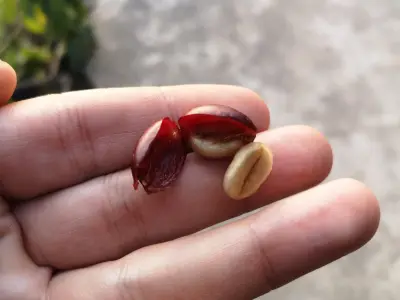
Coffee and climate: what is actually changing on the farms
A plant with narrow requirements
We have been buying coffee for over fifteen years and see what suppliers offer change from year to year. The reason lies at the source, on the farm.
Arabica grows best within a narrow temperature range, roughly between eighteen and twenty-two degrees. Above it flowering falls out of step and the fruit ripens unevenly.
It also needs a dry season and a wet one in a definite order. Rain at the wrong moment can trigger out-of-season flowering, and the harvest then stretches over weeks instead of days.
Robusta tolerates more: higher temperatures, lower altitudes and irregular rainfall. That is why its share of world production is rising, and not because of a fashion for bitterness.
These requirements explain why coffee is a sensitive commodity. You cannot move it a few hundred kilometres sideways, because along with latitude you would need to move altitude, soil and the rhythm of the seasons.
What producers report
The first change concerns predictability. Farmers speak less about a warmer climate and more about seasons that are no longer punctual.
The second is planting moving uphill. Where arabica once grew at six hundred metres, it is now planted higher, because the lower ground has become too warm. Altitude, however, is not infinite.
The third is disease. Coffee leaf rust, a fungus once held back by cool nights, now appears at altitudes it did not reach before.
The fourth is water. Droughts alternating with heavy rain destroy flowers and complicate drying the harvested fruit, and drying is where a good lot is most easily lost.
The practical effect is that differences between crop years are larger than they used to be. The same producer can deliver two lots with markedly different profiles.
For roasters that means more work composing blends, because the goal is unchanged: a consistent taste in the customer's cup.
What this does not mean
It is worth separating observations from catastrophic headlines, because the latter usually get the timescale wrong.
Coffee will not disappear in the coming years. The growing area is shifting, not shrinking to nothing, and farmers have long been adapting varieties and planting methods.
What is changing is the structure of supply: more robusta, more resistant varieties, less predictable high-altitude single origins.
Shade is also gaining importance. Growing under trees lowers the temperature around the plants by a few degrees and stabilises humidity, and it is returning after decades of full-sun planting.
Nor should one expect everything to depend on climate. The quality of a lot still depends most on how the fruit was picked and dried, that is, on people's work.
We covered that side at greater length in our piece on growing regions.
How it comes back to the cup
The customer does not see the farm, but the effects show up in three places.
The first is blend composition. Blends increasingly carry a larger share of robusta, which gives fuller body and denser crema but fewer floral notes.
The second is the availability of single origins. Lots from individual farms are smaller and sell out sooner, and the next delivery does not always taste the same.
The third is seasonality. A region's fresh crop now arrives in different months than it used to, so the coffee you like may be unavailable for a while.
None of this means worse coffee. It does mean that blends are the safer choice if you value consistency, and single origins are best treated as a seasonal pleasure.
In our range of coffees we try to keep a stable core of blends and rotate seasonal references around it.
What depends on us in the kitchen
A single household's influence on the climate is small, but its influence on coffee waste is not. And that is the part you can control.
The largest loss is coffee thrown away because it went stale. Buying the amount you get through in three or four weeks does more here than any certificate on the pack.
The second matter is the dose. A wrong grind means another cup poured down the sink, and with it wasted water and energy.
The third is packaging. ESE pods are compostable, some capsules are recycled through dedicated schemes, and used grounds have more household uses than people expect.
What to do with spent capsules we set out in a separate piece, together with what collection points actually accept.
We keep compostable ESE pods in the range precisely because they solve the waste problem without giving up convenience.
Three things to close
First, coffee is an agricultural product and has always been variable. What is new is that variability has grown, not that it appeared.
Second, blends exist partly to smooth that variability. They are not inferior to single origins, they simply have a different aim.
Third, in your kitchen the biggest difference comes from freshness and brewing method, not from a certificate or the country on the pack.
If a favourite reference disappears for a few weeks, we will gladly suggest a substitute with a similar profile rather than simply one from the same country.
Our team is available: get in touch and describe what you have been drinking so far.
Popular products
All products
More







More on this topic
More

Coffee capsules vs traditional: what to choose for home?
Read article


Coffee Capsules Guide: How to Choose Your Perfect Taste
Read article
5 myths about capsule coffee
Read article
How to properly store coffee and coffee capsules: expert advice
Read article

Coffee at the office: choosing the system, the machine and the accessories for a team
Read article
What to serve with coffee the Italian way: sweets, pistachio creams and specialities
Read article
Decaf coffee and infusions: what to drink in the afternoon and evening
Read article
How to taste coffee at home: a guide for beginners
Read article
Coffee brewing methods: moka pot, espresso, French press and filter — which to choose
Read article
Used coffee grounds: what to do with them instead of throwing them away
Read article
Coffee and sport: when caffeine helps and when it gets in the way
Read article

Caffeine in the cup: how much we really drink
Read article