





Coffee in cosmetics: caffeine and green coffee in skin and hair care
Why coffee ended up on cosmetic ingredient lists
Caffeine and green coffee extract appear ever more often on the ingredient lists of eye creams, body lotions, scrubs and shampoos. We have worked with coffee for years, so customers regularly ask us about coffee on the skin: fashionable addition or ingredient with a real basis.
The answer sits in the middle. Coffee gives the cosmetics industry two different raw materials: pure caffeine, and the extract or oil obtained from the unroasted bean. Each goes into products for a different reason.
In this guide we explain what manufacturers see in these ingredients, what studies observe and what is reasonable to expect. The effects of drinking coffee are not covered here; we wrote about them separately in our post on coffee and health.
We start with caffeine, the longer established of the two.
Caffeine: a small molecule that crosses the skin easily
Caffeine has two features that formulators appreciate. It is a small, water-soluble molecule that crosses the skin barrier with relative ease, which is why it often serves as a reference substance in skin penetration studies.
In finished products its concentration is usually a few percent. It appears mainly in eye-area products, body products described as firming or smoothing, and shampoos or scalp tonics.
The literature describes several mechanisms. Applied to the skin, caffeine affects microcirculation and briefly narrows small blood vessels, which around the eyes is perceived as reduced puffiness. In the laboratory it shows antioxidant properties. In body products manufacturers point to its role in the breakdown of fat inside cells, and in hair products to its action on hair follicles.
There is also a simpler reason: the cool, refreshing feel a caffeine product leaves behind. For many people that sensation matters more than any mechanism in a publication.
How much caffeine a cup of coffee holds is covered in our post on caffeine in the cup. A caffeine cosmetic is a different scale and a different route; it does not replace the morning espresso.
Green coffee: the bean before roasting and its chlorogenic acids
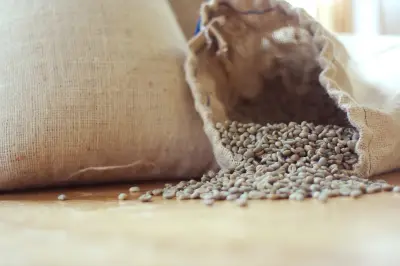
Green coffee is simply the bean before roasting. The beans that reach the cup from our whole bean and ground coffee section have been roasted at high temperature: that creates the aroma we expect from espresso, but other compounds decrease.
The most important of these are chlorogenic acids, a group of polyphenols with antioxidant properties. Studies comparing raw and roasted beans agree that green coffee contains the most and that the amount falls as the roast gets darker. That is why cosmetics use the bean before roasting rather than the one we brew.
The green bean yields two raw materials. The first is the extract, standardised for chlorogenic acids and caffeine and added to creams, gels and lotions as an antioxidant ingredient. The second is green coffee oil, pressed from the beans and used in body care as an emollient; its skin compatibility has been examined in studies with volunteers.
The extract has a practical advantage too: it does not bring the intense smell of roasted coffee into a cream, an asset in a café but an obstacle in a face product.
What can realistically be expected
Honesty is needed here. A cosmetic with caffeine or green coffee remains a cosmetic, not a medicine, and the regulations do not allow therapeutic claims. The effects described in studies are generally modest and temporary, and they vary from person to person.
Less visible puffiness under the eyes lasts a few hours and comes from the momentary narrowing of vessels, not from a lasting change in the skin. Smoother skin after a coffee scrub is largely the work of mechanical exfoliation and the oily base, which any well-made scrub provides.
For caffeine body products the studies are few, carried out on small groups, and describe a small, temporary change in the look of the skin rather than a lasting result. Much depends on concentration, product form and regular use. Such cosmetics are best treated as part of a care routine, not as a way to change body shape.
The same applies to the antioxidants in green coffee: their activity in the test tube is well documented, but how much reaches the skin after a cream is applied depends on the formula and is still being researched. A realistic expectation is a cream that absorbs well, smells pleasant and supports daily care, not an ingredient that turns back time.
The home scrub made from coffee grounds is a separate subject, described in our post on the second life of coffee grounds, so we do not repeat it here.
Green coffee extract cosmetics in our shop
In our Sandemé cosmetics section we carry an Italian care line whose common thread is green coffee extract, standardised for its content of chlorogenic acid and caffeine. The line includes a face cream, a body cream, a hand cream, a body scrub, a shower gel, a cleansing gel and a cocoa butter lip balm.
In these products the extract is the antioxidant ingredient, but not the only active one. The formulas also contain jojoba oil, shea butter, hyaluronic acid and vitamin E, the classic moisturising and emollient ingredients. The scrub is a cream with coffee and silica microgranules that exfoliate mechanically; the rest are formulas for everyday care.
The manufacturer states that the products are dermatologically tested. We do not repeat the promises from the packaging; we describe composition and product type, and leave the verdict to the skin after a few weeks of use.
Green coffee on the skin goes well with a cup of coffee in the kitchen. Our coffee section holds roasted beans, ground coffee, capsules and pods, and for the evening the herbal infusions of Sandemetrio, a producer from Salento that packs teas and herbs in ESE pods.
Patch test first, and when to ask a dermatologist
Caffeine and plant extracts are generally well tolerated, but it is wise to try any new cosmetic on a small area of skin first, for example the inside of the forearm, and wait a day, especially with fragranced products and scrubs with granules.
A scrub does not belong on irritated skin, small abrasions or freshly shaved skin. Sensitive skin and skin prone to visible capillaries usually tolerate a gentle cream better than intense exfoliation, even with the same lead ingredient.
People with skin conditions such as atopic dermatitis, psoriasis or rosacea, and people with a diagnosed allergy to plant ingredients, should ask a dermatologist before use. A cosmetic does not treat these conditions or replace therapy.
If you have questions about the composition of a particular product or about which one suits a given skin type, please contact us. The Maracatú team will gladly suggest where to start.
Image: unroasted green coffee, DeaPeaJay, CC BY-SA 2.0 (Wikimedia Commons).
Popular products
All products
More




More on this topic
More

Coffee capsules vs traditional: what to choose for home?
Read article

Coffee Capsules Guide: How to Choose Your Perfect Taste
Read article

5 myths about capsule coffee
Read article
How to properly store coffee and coffee capsules: expert advice
Read article

Coffee at the office: choosing the system, the machine and the accessories for a team
Read article

What to serve with coffee the Italian way: sweets, pistachio creams and specialities
Read article
Decaf coffee and infusions: what to drink in the afternoon and evening
Read article

How to taste coffee at home: a guide for beginners
Read article
Coffee brewing methods: moka pot, espresso, French press and filter — which to choose
Read article
Used coffee grounds: what to do with them instead of throwing them away
Read article

Coffee and sport: when caffeine helps and when it gets in the way
Read article

Caffeine in the cup: how much we really drink
Read article