





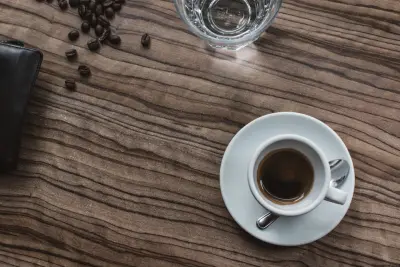
Caffeine in the cup: how much we really drink
How much caffeine is in a single cup
The question comes up regularly, usually when someone is choosing an afternoon coffee. The answer is: it depends, and it depends on the volume of the drink rather than on how strong it tastes.
A small espresso, whether from a pump machine or a capsule, normally holds between 60 and 80 mg of caffeine. A filter cup of around two hundred millilitres sits most often between 90 and 140 mg. Moka coffee lands close to filter, because the volume is comparable.
The range is wide because four variables sit behind every figure: the botanical species of the bean, the dose, the grind and the amount of water pushed through the coffee.
That is why two cups from the same pack can differ by several tens of per cent while looking identical.
One point is worth settling at the start: bitterness is not a measure of caffeine. It comes mainly from the roast level and from how the extraction runs, and both have less to do with the caffeine dose than most people assume.
Why an espresso holds less caffeine than a big cup
Espresso has the reputation of the strongest coffee, and in one sense it truly is: per millilitre nothing comes close. The catch is that we drink very little of it.
Twenty five millilitres of a highly concentrated drink carry less caffeine than two hundred millilitres of something several times weaker. It is plain arithmetic, even if perception says otherwise, because espresso is dense, intense and leaves a long finish.
The second factor is contact time between water and coffee. In a pump machine the water crosses the grounds in twenty seconds or so; in a filter brewer it takes minutes. Longer contact means a larger share of the caffeine ends up in the drink.
Hence the advice we repeat to customers after a full flavour without a heavy dose: a ristretto works better than a lungo drawn from the same capsule. More water means more caffeine, even when the result tastes milder.
The same principle explains why the big office mug catches people out. It does not taste strong, but the volume does the work.
What actually changes the caffeine content
Bean species. Robusta carries roughly twice the caffeine of arabica. Neapolitan style blends, built on robusta, deliver a noticeably higher dose in the same cup than a hundred per cent arabica. We state the composition in the product pages of the coffee section, and blends from roasters such as Borbone lean on robusta deliberately, because that is what gives the dense crema and the dry finish.
Dose. Seven grams in the basket against nine grams is a quarter of a difference. In a capsule the dose is fixed by the producer; with ground and whole bean coffee it is set by whoever brews.
Roast level. Contrary to common belief, a dark roast does not raise caffeine. The molecule holds up well at roasting temperatures, so the gap between light and dark stays secondary to species and dose.
Grind and extraction time. A finer grind increases contact surface and speeds the caffeine into the drink. A longer extraction does the same. That is why filter and immersion methods score high despite their gentle taste.
Decaffeinated coffee is a separate case, where only a residual amount remains. We covered it at length in our piece on decaf and evening infusions.
How much is a lot: some reference points
In its scientific opinion, the European Food Safety Authority regards an intake of up to 400 mg of caffeine a day as raising no concern for a healthy adult, with single servings of up to 200 mg treated the same way. For pregnancy and breastfeeding the stated daily figure is halved.
Translated into cups, 400 mg is roughly five espressos or three large filter mugs. Most of our customers sit inside that range without any effort at all.
The second quantity worth keeping in mind is time. The body usually needs four to six hours to clear half of the caffeine it has taken in, and in some people the process runs slower. A coffee at five in the afternoon is still at work at ten in the evening, by which point nobody connects it with a late night.
The aim is not to count milligrams. The aim is to know where one's own limit lies and to keep a coffee at hand that makes it easy to stay below it.
These figures are informational. During pregnancy, while on medication or with cardiac conditions, please follow medical advice rather than a table.
How to lay out the day
The pattern that works most often among our customers is a simple one. A firm robusta based blend in the morning, in short form. The same coffee after lunch, without stretching it. Something gentler in the late afternoon, and a decaffeinated coffee or a caffeine free infusion in the evening.
With a capsule machine the easiest arrangement is to keep two references side by side, one strong and one decaffeinated. Capsules and pods compatible with every common system sit in the coffee section, while the system pages, for instance Nespresso® or A Modo Mio®, make it simpler to stay on the right format.
With ground and whole bean coffee the adjustment is easier still, because the dose is set by whoever brews. The selection is in whole bean and ground coffee.
One last observation concerns habit. The body adapts to a steady dose, so someone on four cups a day feels them less than someone on one. That is no reason to raise the dose; if anything it is an argument for stepping down now and then to rediscover what coffee really gives.
If any doubt remains about which blend suits a particular machine and a particular hour, please get in touch. The Maracatú team is glad to help.
Popular products
All products
More





More on this topic
More
Coffee capsules vs traditional: what to choose for home?
Read article

Coffee Capsules Guide: How to Choose Your Perfect Taste
Read article

5 myths about capsule coffee
Read article
How to properly store coffee and coffee capsules: expert advice
Read article
Coffee at the office: choosing the system, the machine and the accessories for a team
Read article
What to serve with coffee the Italian way: sweets, pistachio creams and specialities
Read article
Decaf coffee and infusions: what to drink in the afternoon and evening
Read article
How to taste coffee at home: a guide for beginners
Read article
Coffee brewing methods: moka pot, espresso, French press and filter — which to choose
Read article
Used coffee grounds: what to do with them instead of throwing them away
Read article
Coffee and sport: when caffeine helps and when it gets in the way
Read article
Used capsules and pods: what to do with them
Read article