





ESE Pods: What They Are, How They Work and Which Machines Take Them
The ESE pod: a single espresso dose sealed in paper
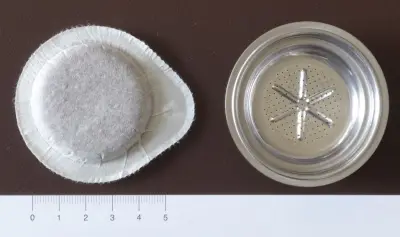
An ESE pod is a single dose of ground coffee, pressed into a disc and sealed between two layers of filter paper. The letters stand for Easy Serving Espresso; the number 44 on every product of this kind is the diameter of the disc in millimetres. Inside there are about 7 g of coffee, a barista's dose for one espresso.
Unlike a capsule, a pod has no aluminium or plastic shell. The paper is both packaging and filter, so after brewing all that is left is a damp paper disc with the grounds inside.
The idea dates from the late 1980s and the Italian roaster Illy; in the late 1990s a group of roasters and machine makers wrote it down as a shared, open standard. Open means any manufacturer may make pods and machines in this size without a dedicated licence.
In practice this means choice. In our ESE 44 mm pods section, next to our own line, there are pods from the Neapolitan roaster Borbone, from Illy and Lavazza, plus herbal infusions and flavoured coffees in the same format, all for the same machine.
How the pod works inside the machine
The principle is the same as in a portafilter machine with ground coffee. The pod sits in the portafilter basket or in the chamber of a pod machine, and the pump pushes hot water through it under pressure. The paper holds back the grounds; espresso with crema arrives in the cup.
The difference: the three steps that decide the result in a portafilter, grinding, dosing and tamping, were done at the roastery. The coffee is compressed with a set force, so there is nothing to correct at home and the machine receives an identical dose every time.
Hence a repeatable espresso even for people who have never adjusted a grind, and less room for experiment: strength and profile are chosen at purchase, not at the machine.
A pod is designed for one classic espresso, usually around 30-40 ml. A larger cup from the same dose comes out watery, so for a longer coffee brew the espresso and top it up with hot water.
Which machines take ESE pods
The first group are machines designed solely for this format: compact, with about a litre of water and a handle whose basket is sized for the 44 mm disc. Operation comes down to inserting the pod, closing the handle and pressing a button. Such machines, in several colours, are in our ESE pod machines section.
The second group are classic portafilter machines: many manufacturers include a pod basket or offer one as an accessory. It is shallower than the standard basket, with a raised pattern on the bottom that spreads the water evenly over the paper. Whether a given model has this option is best confirmed in the manual or on the manufacturer's website.
Pods do not fit bean-to-cup automatic machines or capsule machines such as Nespresso®, Dolce Gusto®, A Modo Mio® or Caffitaly®. Each has its own capsule shape and its own way of piercing it, which a paper disc was never designed for.
How to brew so the pod gives its best
One pod, one espresso. The disc goes flat in the centre of the basket, with the paper edge folded inwards so it does not end up under the gasket. Paper sticking out of the basket lets water bypass the coffee and the shot comes out weak.
A pod is never tamped. The coffee inside was compressed at the roastery; extra pressure crushes the paper and disturbs the flow. Close the handle normally, without force.
Before the first coffee of the day, run a little water through the empty portafilter: it warms the basket and group head and flushes out residue from the previous brew. Warm the cup too; a small espresso cools within seconds in cold porcelain.
After brewing, remove the pod straight away: left in the hot handle, it releases bitter, over-extracted residue that can be tasted in the next cup. Rinsing the basket under running water is enough.
Whatever the format, the machine runs on tap water, which leaves scale in the boiler and group. Regular descaling, with products from our filters and descalers section, keeps temperature and pressure at the level where a pod actually produces crema.
Paper, composting and what is left after the coffee
Our own line of ESE pods, in the 100% Arabica (intensity 7/10), Sublime, Gran Crema and Intenso (10/10) blends plus a decaffeinated version, is labelled compostable. So are the Borbone pods Rossa, Blu, Nera, Oro and the decaffeinated Dek. All are described on the Maracatú and Caffè Borbone brand pages.
The label refers to the disc itself: filter paper and coffee, both organic material. A used pod therefore belongs in bio-waste wherever the municipality accepts compostable packaging with kitchen scraps.
Some caution is needed: some facilities accept such packaging, others do not, and the individual municipality's rules decide. If in doubt, tear the pod open, tip the grounds into bio-waste or onto the compost and dispose of the paper according to local rules. The individual wrapper, usually a plastic film, goes with plastics and metals.
How to tell capsule materials apart, empty them and why "empty first, then sort" applies to every format is in our post on what to do with used capsules and pods.
Storage, a comparison with capsules and who this format suits
Each pod is sealed individually in an airtight wrapper, so the supply needs no special care: a closed box in a cool, dry place away from light and strong smells. An opened pod is not set aside for later; the paper absorbs moisture and odours within hours. General rules are in our post on storing coffee and capsules.
Next to the machine, a container or drawer for a few days' supply works well; models for pods are in our containers for capsules and pods section. The rest stays in the closed carton.
Compared with capsules, the facts are simple. A capsule has a rigid shell that protects the coffee from oxygen and allows different drink volumes, in some systems also milk drinks. A pod gives one espresso dose, follows a standard shared by many producers and leaves only paper and grounds. Neither format is better in general; each is better at something.
ESE pods suit people who drink classic espresso, want a choice of roasters in a single machine and prefer not to dismantle any packaging after the coffee. They also suit small offices where several people use the machine, because there is nothing to set wrongly.
If you are unsure whether your machine accepts pods, or which blend makes a good start, contact us: the Maracatú team will be glad to advise.
Image: ESE pod and pod filter basket, Phrontis, CC BY-SA 3.0 (Wikimedia Commons).
Popular products
All products
More



More on this topic
More
Coffee capsules vs traditional: what to choose for home?
Read article


Coffee Capsules Guide: How to Choose Your Perfect Taste
Read article
5 myths about capsule coffee
Read article
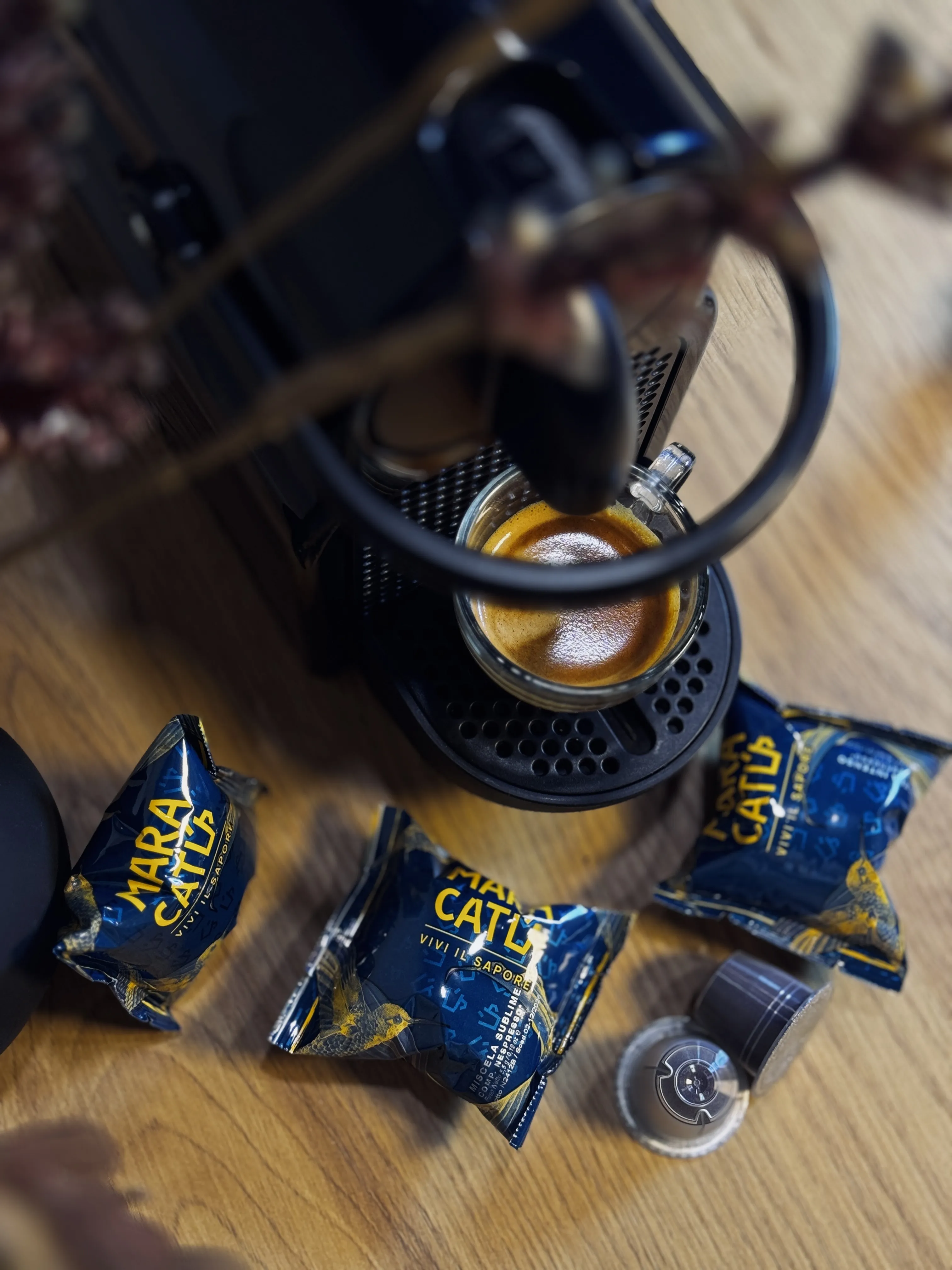
How to properly store coffee and coffee capsules: expert advice
Read article
Coffee at the office: choosing the system, the machine and the accessories for a team
Read article
What to serve with coffee the Italian way: sweets, pistachio creams and specialities
Read article
Decaf coffee and infusions: what to drink in the afternoon and evening
Read article
How to taste coffee at home: a guide for beginners
Read article
Coffee brewing methods: moka pot, espresso, French press and filter — which to choose
Read article
Used coffee grounds: what to do with them instead of throwing them away
Read article

Coffee and sport: when caffeine helps and when it gets in the way
Read article
Caffeine in the cup: how much we really drink
Read article