





Used capsules and pods: what to do with them
What is actually left after brewing
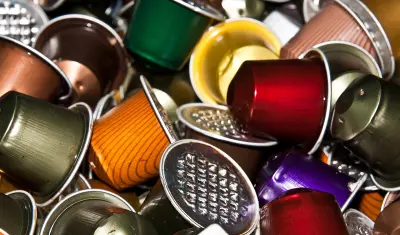
A used capsule is two very different things inside one object. Inside sit a few grams of wet grounds, that is organic material. Outside is the packaging: aluminium, plastic or a compostable material.
The whole difficulty comes from the two parts being joined and sealed. As long as they stay together no collection stream is the right one: packaging does not belong in organic waste, and the contents do not belong with metals and plastics.
The scale becomes clear at household level. Two coffees a day come to roughly seven hundred capsules a year, which is a few kilograms of grounds and several hundred grams of packaging on its own.
The good news is that separating the two takes a matter of seconds and changes the picture entirely. The bad news is that nobody does it instinctively, because a spent capsule looks like a single object.
Paper ESE pods are the exception we return to below: they are built differently and cause the least trouble.
Aluminium, plastic, compostable: how to tell them apart
Aluminium. Recognisable by the sound and by the fact that once crushed it does not spring back. The material survives many recycling cycles with little loss, which makes an emptied aluminium capsule the most valuable of the three.
Plastic. The capsule gives under the fingers and springs back, and the lid is often a foil. Plastic with an aluminium layer on top is a multilayer material and is harder to recycle, because the layers have to be separated first.
Compostable material. The producer always states it on the pack, usually citing the EN 13432 standard. One detail deserves attention: that standard describes industrial composting, at a high and steady temperature. A garden composter rarely reaches those conditions, so breakdown takes considerably longer.
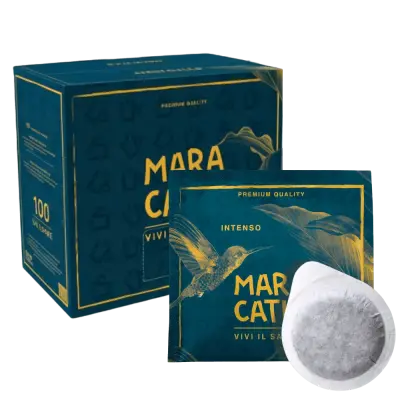
Paper ESE pods. These are simply a paper filter with coffee inside, no metal and no plastic. The whole pod goes into organic waste wherever the local scheme collects it. Formats and coffees in this system are in the ESE 44 mm pods section.
If the packaging says nothing about the material, the quickest route is the product page on the shop: for every item in the coffee section we state the system and the capsule type.
Where it really belongs
One rule is worth remembering: empty first, sort second. A capsule with grounds still inside is mixed waste whatever material it is made of.
Aluminium, once emptied and briefly rinsed, goes into the metals and plastics stream. Plastic capsules follow the same stream, even though recovering them is more laborious. The grounds go into organic waste or onto the compost heap.
Compostable materials are the most ambiguous case in Poland. Some plants accept them with organic waste, others do not, because on a sorting line they are hard to tell from plastics. The rules are set by each municipality, so the only reliable answer sits on the local authority website.
We would advise against cutting capsules open with a knife or burning them. Lifting the lid and shaking the contents out is enough, and it works best once the capsule has cooled and dried a little.
What to do with the grounds themselves we covered separately, in our article on what to do with them instead of throwing them away.
A daily rhythm: a container next to the machine
It all comes down to convenience. If emptying capsules means a trip to a sink in another room, it will not happen. If a container stands next to the machine, it happens by itself.
The arrangement we recommend most often has three parts: a container for spent capsules right by the machine, a small vessel for grounds, and a fixed moment in the week when both get emptied.
Containers and drawers for capsules and pods are in the capsule and pod holders section. Drawer models usually hold a few days of use and keep the moisture in one place.
One practical warning: wet capsules left in a closed container start to mould within days. An open or ventilated vessel, emptied regularly, works better.
People who brew at work usually go a step further and set up a single container for the whole team. We wrote about that in our piece on coffee in the office.
Less waste at the source
Sorting solves half the task. The other half is producing less packaging in the first place.
The simplest route runs through format. Whole bean and ground coffee gives one pack per few hundred grams instead of dozens of separate portions, and its grounds go straight into organic waste. The selection is in whole bean and ground coffee.
The second route is ESE pods, where the packaging is the paper filter itself. Machines built for the format are in the ESE pod machines section.
The third is simply the larger multipack of capsules, which for the same number of coffees leaves less cardboard and less film behind.
None of these beats the others in every situation: what matters is which machine stands in the kitchen and how many coffees come out of it each day. If there is any doubt about which format makes most sense in a given household, please get in touch. The Maracatú team is glad to help.
Image: used aluminium coffee capsules, Andrés Nieto Porras, CC BY-SA 2.0 (Wikimedia Commons).
Popular products
All products
More




More on this topic
More

Coffee capsules vs traditional: what to choose for home?
Read article


Coffee Capsules Guide: How to Choose Your Perfect Taste
Read article
5 myths about capsule coffee
Read article
How to properly store coffee and coffee capsules: expert advice
Read article

Coffee at the office: choosing the system, the machine and the accessories for a team
Read article

What to serve with coffee the Italian way: sweets, pistachio creams and specialities
Read article
Decaf coffee and infusions: what to drink in the afternoon and evening
Read article
How to taste coffee at home: a guide for beginners
Read article
Coffee brewing methods: moka pot, espresso, French press and filter — which to choose
Read article
Used coffee grounds: what to do with them instead of throwing them away
Read article

Coffee and sport: when caffeine helps and when it gets in the way
Read article

Caffeine in the cup: how much we really drink
Read article