





Italian coffee types: from espresso and ristretto to cappuccino and macchiato
The Italian bar and its language: why the coffee names matter
In an Italian bar, asking for "un caffè" is enough to receive an espresso. For many people arriving from Poland this may be the first surprise.
The same Italian names now appear on café menus in Poland and on capsule boxes: ristretto, lungo, macchiato, cappuccino, latte macchiato.
They do not always mean the same thing, however. The definitions of the individual coffees vary depending on the bar, the region and the habits of the barista.
For this reason it is worth knowing the general meaning of each name rather than exact proportions. In one bar the lungo will be a little longer, in another a little shorter, but it will always be a longer coffee than an espresso.
We work with coffee every day and we know how many questions these names raise: how a ristretto differs from an espresso, whether latte macchiato is the same as caffè latte, what actually lies behind the name marocchino.
In this guide we look at short coffees without milk, coffees with milk and a few less familiar names you may come across in an Italian bar.
We also look at the customs linked to drinking coffee in Italy and suggest how to prepare these drinks at home, with a machine, pods or a moka pot.
Espresso, ristretto, lungo and doppio: short coffees without milk
The basis of most Italian coffees is the espresso: a small, concentrated coffee obtained by pushing hot water under pressure through finely ground coffee.
It is served in a small cup and has a layer of crema on top, a dense, light brown foam.
An espresso can also be ordered as a doppio, meaning double: two portions of espresso served in a single, slightly larger cup.
A ristretto is an even shorter espresso. The name itself means "restricted" in Italian: it is prepared with the same amount of coffee but less water.
The result is usually a more concentrated drink with a bolder flavour, although it fits in the same small cup.
A lungo, meaning "long", is the opposite of a ristretto: more water passes through the same portion of coffee, and the drink is larger and usually milder.
A lungo differs from a caffè americano. In an americano the espresso is diluted with hot water only after brewing, whereas in a lungo all the water passes through the coffee.
The same three words, ristretto, espresso and lungo, appear on machine buttons and on capsule boxes. They usually refer to the length of the drink, from the shortest to the longest.
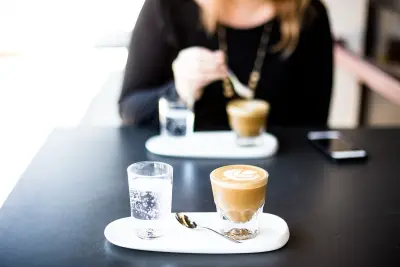
All these coffees are served without milk, in a bar most often in a warmed cup with a saucer and a teaspoon.
The boundaries between them are conventional, however: what one bar calls a ristretto may simply be a short espresso in another.
Macchiato, cappuccino, latte macchiato and caffè latte: coffees with milk
The second group are coffees with milk. Here the differences mainly concern the proportion of coffee to milk and the order in which they go into the cup or glass.
A caffè macchiato is an espresso with a small amount of milk, usually a teaspoon of milk foam, served in an espresso cup. In Italian macchiato means "stained": the coffee is merely marked with milk.
In many bars you can be more specific: macchiato caldo, with warm foam, or macchiato freddo, with a drop of cold milk.
A cappuccino is espresso, hot milk and milk foam, served in a larger cup. The foam is clearly present here, and the proportions depend on the bar and on the barista.
A latte macchiato reverses the order: espresso is poured into a glass of hot, frothed milk and marks the milk. It is usually served in a tall glass, often with visible layers.
A caffè latte is coffee with plenty of milk and a thin layer of foam, or none at all, in a glass or a large cup. It is milder and more uniform than a latte macchiato.
One linguistic detail is useful here: in Italian, latte simply means milk. Anyone who orders just a latte in an Italian bar may receive a glass of milk.
That is why the full name is used when ordering: caffè latte or latte macchiato.
In this group too, definitions are often fluid. A cappuccino has more foam in one bar and less in another, and a latte macchiato in Poland and in Italy may differ in the size of the glass.
The general rule is clear, however: from the macchiato, which has the least milk, to the latte macchiato and caffè latte, in which milk outweighs coffee.
Corretto, marocchino, shakerato and affogato: less familiar names
Beyond the best-known names, an Italian bar offers a few terms that appear less often in Polish cafés.
Each of them means an espresso served in a different way, with an addition that changes its character. Here are four of them:
Caffè corretto, literally a "corrected" coffee: an espresso with a small amount of alcohol, usually grappa, sambuca or brandy. The choice of spirit depends on the bar and on the person ordering.
Marocchino, a small coffee with cocoa and milk foam, usually served in a small glass. In many bars the glass is dusted with cocoa, the espresso is poured in and the foam added, sometimes with another layer of cocoa on top.
Caffè shakerato, an espresso shaken with ice in a cocktail shaker, often with some sugar, served cold in a stemmed glass or a tumbler. Shaking produces a light, delicate foam on top.
Affogato, literally "drowned": a scoop of ice cream, most often cream or vanilla, covered with hot espresso. It is more a dessert than a coffee and often closes a meal.
The recipes for these drinks vary from bar to bar, and even from barista to barista. In one place the marocchino has more cocoa, in another more milk, and the shakerato is sometimes sweetened with syrup instead of sugar.
With caffè corretto it is worth remembering that the alcohol is an addition to be enjoyed in moderation.
If a name on the menu is unclear, the simplest thing is to ask the barista what exactly lies behind it. In an Italian bar that is usually a perfectly natural question.
The customs of the Italian bar: how coffee is drunk in Italy
The Italian bar is not just a list of drinks but also a set of customs worth knowing in order to feel at ease there.
The first concerns the way coffee is drunk. In many bars coffee is taken standing at the counter, quickly, often on the way to work or during a break.
You can of course sit at a table; in that case, in many places, the coffee is brought by a waiter and the moment lasts a little longer.
In many bars, especially in busy spots, you pay first at the till and then, when ordering, show the receipt at the counter. In smaller places the order is sometimes reversed.
The second custom is the glass of water. In many bars it is served with the espresso and, according to a widespread tradition, it is drunk before the coffee to prepare the palate. It is not a compulsory rule, however.
The third custom concerns the cappuccino. In Italy it is traditionally a morning drink, taken with breakfast, while after lunch or dinner an espresso is more usually ordered.
Here too there is no obligation: a cappuccino in the afternoon is usually served without comment, and many people, in Italy as well, drink it at different times of day.
The same goes for sugar: sachets or a sugar bowl usually stand on the counter and everyone sweetens as they see fit.
All these customs are widespread but not universal. They differ between regions, cities and even neighbouring bars, and everyone may drink coffee the way they like.
How to order coffee in other countries and how to drink good coffee away from home is covered in our article on coffee on the move.
How to make these coffees at home: machine, pods, moka pot and milk frother
Most of the coffees described can be made at home, and the choice of equipment depends on which of them we drink most often.
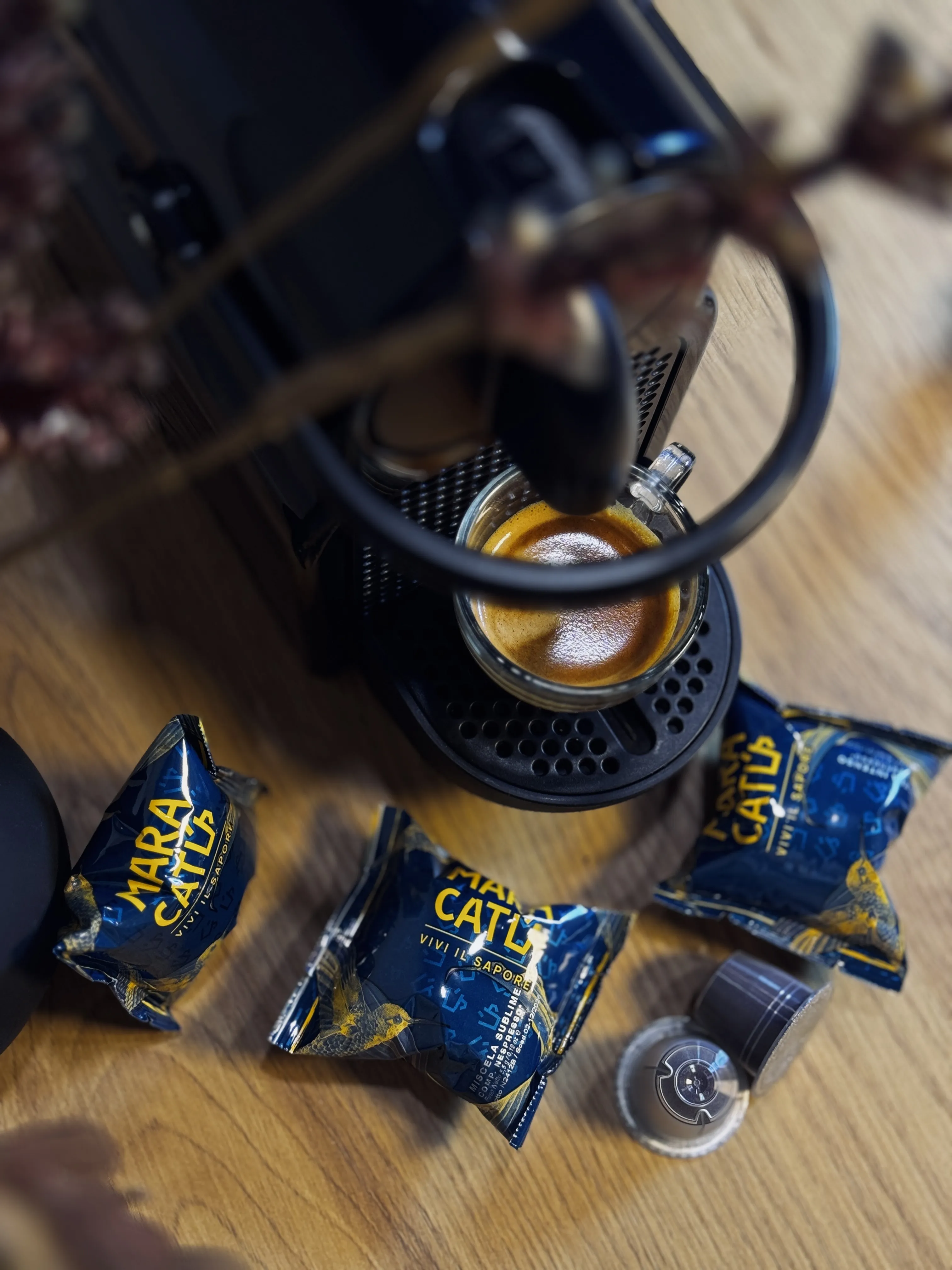
A capsule machine makes espresso and lungo at the touch of a button, and on many models the length of the coffee can be programmed. We offer blends of different intensities among our Nespresso® compatible capsules.
An ESE pod machine gives one portion of classic espresso from each pod; for a doppio it is enough to brew two. The range itself is in our ESE 44 mm pods section.
What exactly this format is and which machines it fits is explained in our article on ESE pods.
A moka pot does not make espresso in the strict sense, but an intense coffee that many Italians drink every day at home. With hot milk added it can become a home version of caffè latte.
It needs whole-bean or ground coffee with a grind suited to this method. How the moka pot works and how it differs from an espresso machine is described in our article on coffee brewing methods.
For coffees with milk a frother is useful. It may be the steam wand on the machine, an electric frother or a manual one; each allows you to prepare the foam for cappuccino, latte macchiato or macchiato.
The vessel matters too: a small cup for espresso, a larger one for cappuccino, a tall glass for latte macchiato. Cups and other coffee accessories are in our accessories and cups section, and machines for the various systems in our coffee machines section.
There is no single best solution. Those who mainly drink espresso and ristretto may reach for an intense blend; those who prefer lungo or milk coffees often get on better with a milder one. Our coffee range has suggestions for both, depending on the current assortment.
To sum up: the Italian coffee names describe above all the length of the drink and the amount of milk, not an exact recipe. Knowing the general meaning of each makes it easier to order what you fancy and to recreate your favourite coffee at home.
If you are not sure which blend or which machine will suit your favourite kind of coffee best, contact us: the Maracatú team is always happy to help you choose.
Popular products
All products
More



More on this topic
More
Coffee capsules vs traditional: what to choose for home?
Read article

Coffee Capsules Guide: How to Choose Your Perfect Taste
Read article

5 myths about capsule coffee
Read article
How to properly store coffee and coffee capsules: expert advice
Read article

Coffee at the office: choosing the system, the machine and the accessories for a team
Read article
What to serve with coffee the Italian way: sweets, pistachio creams and specialities
Read article
Decaf coffee and infusions: what to drink in the afternoon and evening
Read article
How to taste coffee at home: a guide for beginners
Read article
Coffee brewing methods: moka pot, espresso, French press and filter — which to choose
Read article
Used coffee grounds: what to do with them instead of throwing them away
Read article

Coffee and sport: when caffeine helps and when it gets in the way
Read article
Caffeine in the cup: how much we really drink
Read article